
Article Summary
- Health-focused DNA testing looks forward, revealing how your body is biologically wired and goes far beyond ancestry alone.
- Your DNA influences how you process food, handle stress, detox toxins, recover, and metabolize substances.
- Genetic testing provides a personalized roadmap for diet, lifestyle, blood work interpretation, and long-term health decisions.
- Your DNA does not change, making raw DNA data a lifelong asset that can be reused as science evolves.
- Genetics is about clarity and long-term health, not quick fixes or medical diagnoses.
What DNA Testing Really Tells You (Beyond Ancestry)
While ancestry testing focuses on historical lineage, health-focused genetic testing looks forward.
Your DNA influences:
- How you process carbohydrates, fats, and proteins
- How efficiently you detox environmental toxins
- How your body responds to stress
- How well you recover from exercise and injury
- How you metabolize caffeine, alcohol, and medications
- How your nervous system handles stimulation and burnout
These aren’t guesses or trends.
They’re biological tendencies encoded in your genome.
Understanding them gives you clarity on why certain diets, supplements, or routines work for you — and why others don’t.
Genetic Testing as a Personalized Health Roadmap
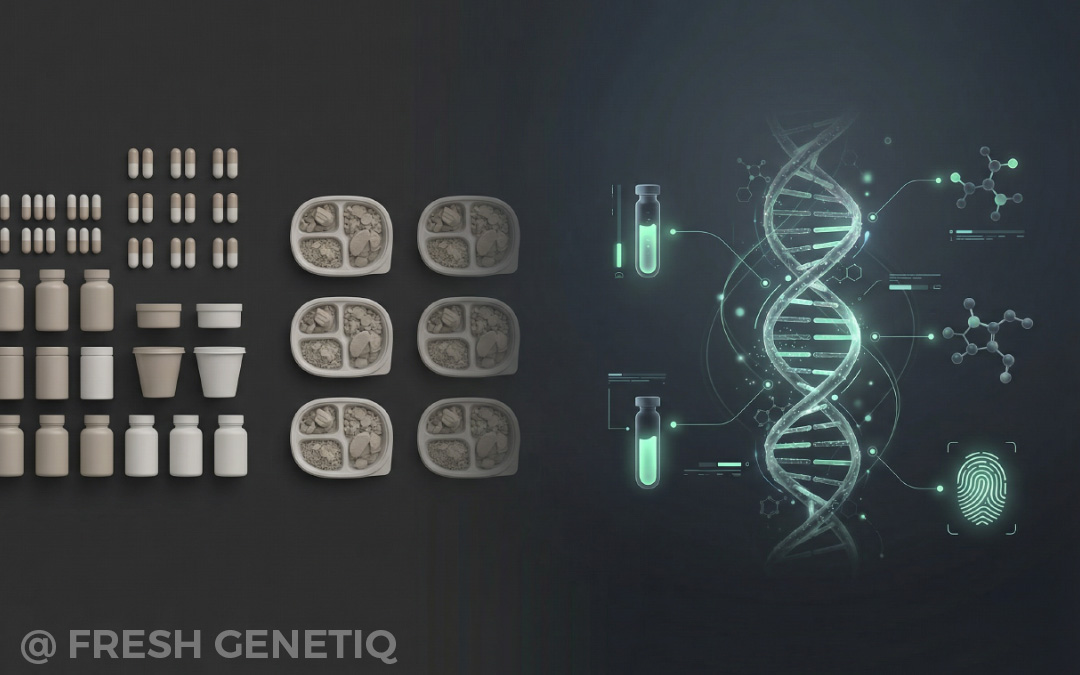
One of the biggest problems in health and wellness today is generic advice.
What works for one person may actively work against another.
That’s where genetic testing changes the game.
Instead of trial-and-error, your DNA can be used as a personalized roadmap to guide:
- Diet choices aligned with how you metabolize food
- Lifestyle decisions that support your stress and sleep biology
- Blood work interpretation with deeper genetic context
- Long-term health strategies based on prevention, not reaction
Genetics doesn’t replace labs, doctors, or lifestyle work — it informs them, making every decision more targeted and efficient.
Raw DNA Data: The Most Important Asset You Can Own
Here’s the most overlooked — and most important — truth about genetic testing:
Your DNA does not change.
Unlike blood markers, hormones, or nutrient levels that fluctuate over time, your genetic code remains the same for life.
That means:
- You only need to test once
- Your data remains relevant forever
- New insights can be extracted as science evolves
When you own your Raw DNA data, you’re not locked into a single report or interpretation.
You can:
- Apply it today
- Re-analyze it in five or ten years
- Use it with new tools, research, or practitioners as they emerge
This is why raw DNA data is fundamentally different from one-time summary reports.
Why Genetics Is About Long-Term Health, Not Quick Fixes
Genetic testing isn’t about instant solutions or medical diagnoses.
It’s about clarity.
Clarity helps you:
- Avoid wasting time on strategies that don’t fit your biology
- Make smarter, more confident health decisions
- Build a long-term approach instead of chasing trends
When you understand your genetic foundation, every health choice becomes more intentional — from food and supplements to training, recovery, and stress management.

The Future of Health Is Personalized — and It Starts With Your DNA
Genetics gives you something most people never get: context.
Not just what to do — but why.
Instead of guessing, copying influencers, or relying on generic advice, DNA testing allows you to work with your biology instead of against it.
And because your DNA never changes, the value compounds over time.
One test.
Lifetime insight.
A clearer path forward.
Key Takeaway
DNA testing isn’t about discovering where you came from.
It’s about understanding how your body works — and using that knowledge to make smarter decisions for the future.
Your DNA is the foundation.
What you build on top of it is up to you.
Related Articles

Medicine Is Shifting From Science to Engineering by Raw DNA Data
For most of human history, medicine has followed the scientific method.
A patient presents symptoms.
A clinician forms a hypothesis.
A treatment is tested.
Weeks pass.
Results are evaluated.
Adjustments are made.
This approach has saved lives, but it is also inherently slow, reactive, and based on trial and error.
Today, for the first time in history, medicine is beginning to change.
It’s moving away from pure experimentation — and toward engineering.
That shift has major implications for preventive health, mental health, and how we make decisions before problems escalate.
If You Understand Methylation, You Understand Genetics
You’ve probably heard the phrase, “Genetic methylation turns genes on and off.”
It sounds important — but it’s rarely explained in a way that actually makes sense.
So let’s simplify what methylation really is, why it matters, and why understanding it gives you a much clearer picture of how your genetics actually function in real life.

Proteins vs Peptides: How DNA Explains the Difference
Most people assume proteins and peptides are basically the same thing.
And in a way, they are.
Both proteins and peptides are made from amino acids.
But the difference between them — and why that difference matters — comes down to structure, size, and function.
More importantly, both proteins and peptides start from the same place: your DNA.