
Article Summary
- Traditional medicine relies on the scientific method, using trial and error to test treatments and observe outcomes over time.
- Modern medicine is shifting toward an engineering approach that analyzes biological data first before making decisions.
- Genetic data helps identify where issues occur within biological pathways instead of assuming the same cause for everyone.
- In areas like mental health, similar symptoms can originate from different underlying biological processes.
- Access to raw DNA data enables a data-first, preventive approach focused on understanding before intervention.
How Traditional Medicine Uses the Scientific Method
In a traditional medical model, the process looks something like this:
- A short consultation
- A hypothesis based on symptoms
- A medication or intervention is prescribed
- Weeks or months pass
- Outcomes are evaluated
- The process repeats
This is science in action. It relies on observation, experimentation, and feedback.
The limitation is that the experiment happens inside the patient’s body, and the feedback is often delayed and subjective.
This approach assumes that similar symptoms usually come from similar underlying causes.
But biology doesn’t always work that way.
Why Medicine Is Becoming More Like Engineering
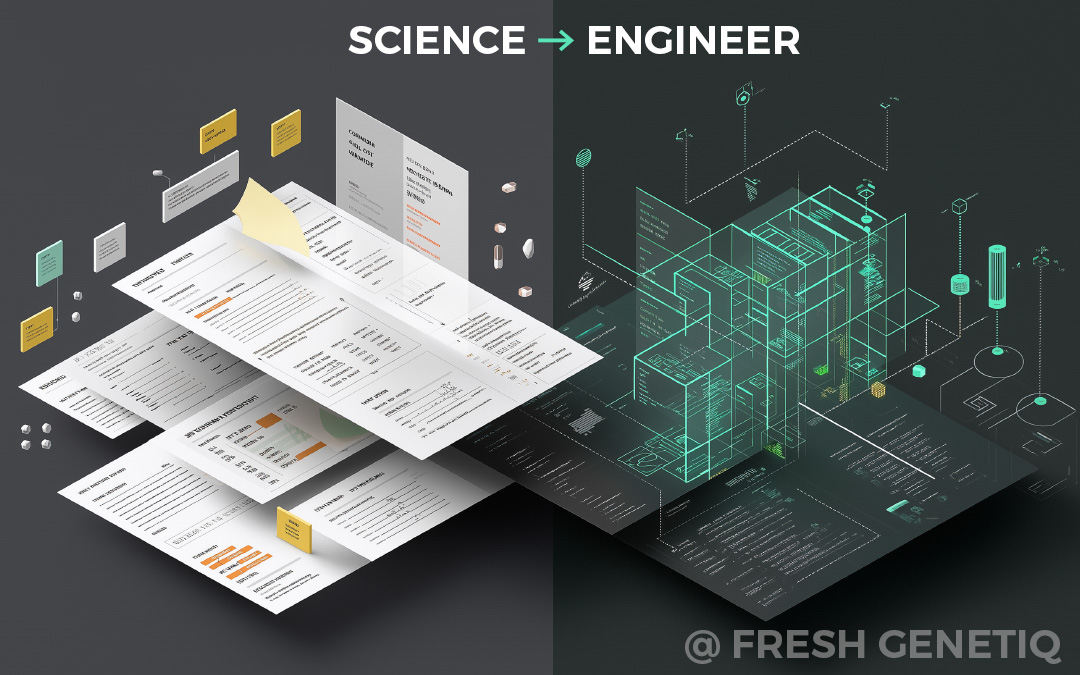
Engineering works differently than science.
Science experiments first, then observes outcomes.
Engineering studies data and systems first, then designs solutions.
Modern medicine is starting to adopt this engineering mindset — especially as access to biological data improves.
Instead of asking, “What drug should we try?”
The question becomes, “Where in the system is the problem actually occurring?”
Because treating everyone the same way assumes the problem is always located in the same place.

Mental Health as an Example of Data-First Medicine
Mental health is a clear example of why this shift matters.
Neurotransmitters like dopamine and serotonin follow complex biological pathways.
They must be built, transported, regulated, and broken down correctly.
In some people, challenges may occur during the build-up (anabolism) of neurotransmitters.
In others, the issue may lie in how quickly neurotransmitters are broken down (catabolism).
Symptoms can look similar — but the underlying biology can be very different.
Without data, treatment becomes guesswork.
With genetic data, it becomes possible to understand where along the pathway deficiency exists, rather than assuming the same intervention works for everyone.
This is the difference between experimenting and engineering.

Raw DNA Data Changes Preventive Medicine
What makes this shift possible is access to raw biological data.
Today, mapping an entire genome and owning raw DNA data costs a fraction of what it did in the past. That accessibility changes everything.
Raw DNA data provides insight into:
- Biological tendencies
- Pathway efficiency
- Genetic variation that affects metabolism, signaling, and regulation
This doesn’t replace doctors, diagnostics, or clinical judgment.
It provides context.
And context allows decisions to be made earlier, more intentionally, and with fewer assumptions.

From Guessing to Understanding
Traditional medicine often tests first and waits.
Engineering looks at the blueprint first.
When you understand the system before intervening, you reduce unnecessary experimentation and improve decision-making.
This doesn’t mean medicine stops being scientific.
It means it becomes data-informed before action is taken.
From guessing to understanding.
From reaction to prevention.
From experimentation to design.
The Future of Medicine Is Data-First
As access to genetic data increases, medicine will continue to evolve.
Not by treating everyone the same — but by understanding biological differences before decisions are made.
Raw DNA data represents an engineering blueprint.
A map of tendencies, not a diagnosis.
Context, not conclusions.
This is where modern medicine is heading.
And it starts by understanding the system before trying to change it.
Related Articles
If You Understand Methylation, You Understand Genetics
You’ve probably heard the phrase, “Genetic methylation turns genes on and off.”
It sounds important — but it’s rarely explained in a way that actually makes sense.
So let’s simplify what methylation really is, why it matters, and why understanding it gives you a much clearer picture of how your genetics actually function in real life.

Proteins vs Peptides: How DNA Explains the Difference
Most people assume proteins and peptides are basically the same thing.
And in a way, they are.
Both proteins and peptides are made from amino acids.
But the difference between them — and why that difference matters — comes down to structure, size, and function.
More importantly, both proteins and peptides start from the same place: your DNA.
DNA Testing Isn’t About Your Past — It’s the Blueprint for Your Future
When most people hear DNA testing, they immediately think of ancestry.
Questions like “Where am I from?” or “Am I 2% Neanderthal?” tend to dominate the conversation.
But that’s a very limited view of what genetics actually offers.
Modern genetic testing isn’t about your past.
It’s about understanding the biological foundation that shapes your future.
Your DNA is the instruction manual your body has been following since birth — and learning how to read it properly can change how you approach nutrition, lifestyle, recovery, and long-term health decisions.